





Moving Forward Newsletter
Vol 3, January 2026
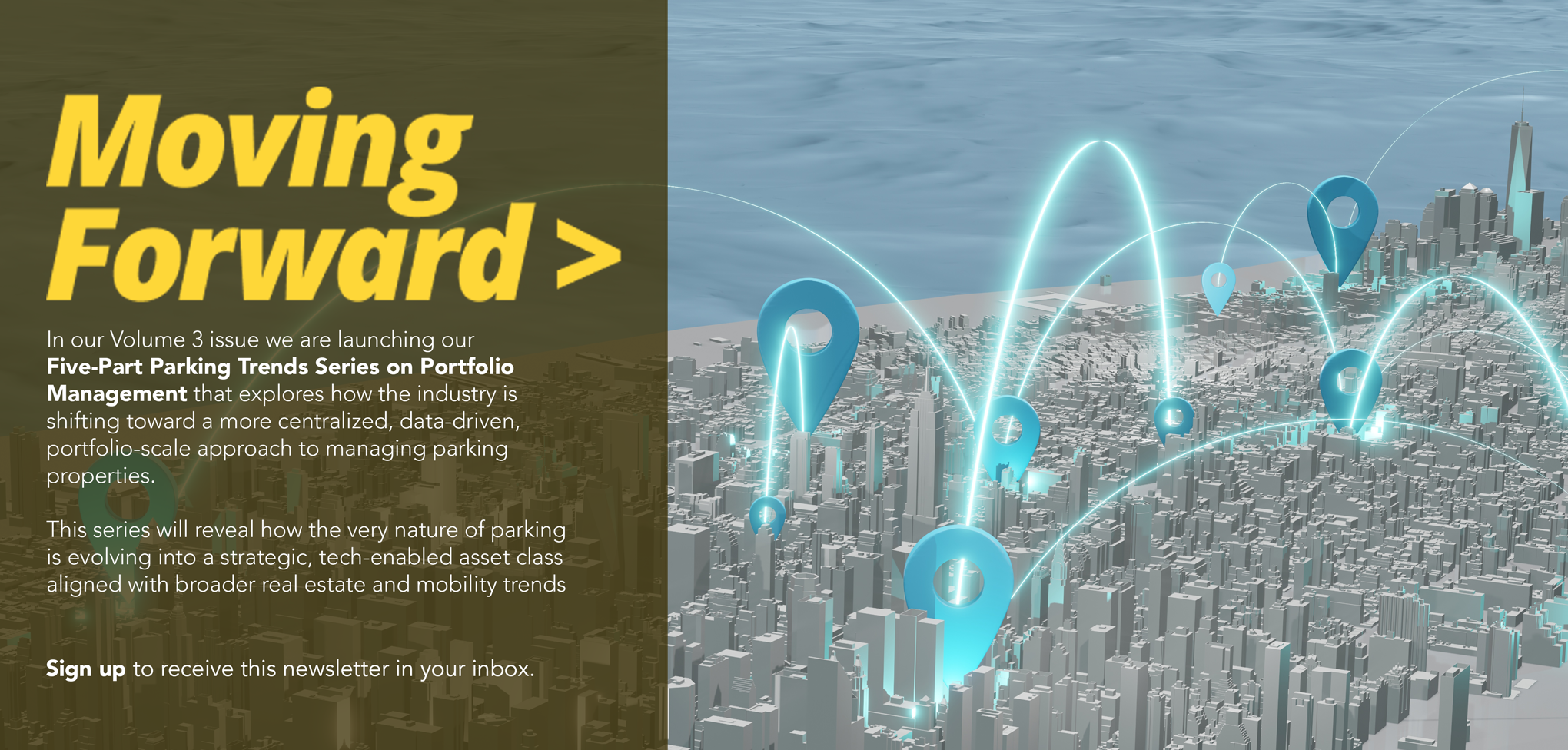
I. Parking Trends Series
Portfolio Consolidation & the Single Point of Contact
Why the Rules of Parking Portfolio Management Are Being Rewritten
Commercial real estate owners across North America have spent the last five years streamlining their operating models. In nearly every building service category—security, janitorial, mechanical, landscaping—consolidation has become the norm. According to JLL and CBRE, leading CRE firms now manage 20–30% fewer vendors than before 2020. Fewer contracts mean fewer administrative burdens, greater consistency across properties, and tighter alignment between building operators and ownership priorities.
Parking, however, remains an outlier. Even as owners modernize their broader portfolios, fragmented, city-by-city relationships still govern parking. A single owner with a regional footprint may interact with three, five, or even seven operators, each with its own managers, reporting formats, pricing philosophies, customer-service practices, and levels of technical maturity. In a post-pandemic landscape defined by hybrid work, fluctuating demands, and compressed profit margins, this fragmentation has become increasingly costly—not only in efficiency, but in decision-making speed, transparency, and owner confidence.
The Need for a Single Point of Contact
Portfolio clients are sending a consistent message: they do not want to manage multiple relationships to understand the performance of what should be a unified portfolio. They want one accountable partner who sees everything—every market, every asset, every pricing decision, every data feed, every operational issue. A single point of contact is no longer a convenience; it is a strategic necessity.
This model reduces communication overhead, eliminates duplicate conversations, and removes ambiguity around shared responsibility. If an owner sees revenue dips or a system fails, they know exactly who to call. And because accountability rolls up through a single relationship, the operator can coordinate across local teams, align on standards, and mobilize consistent solutions. It also creates a transparent governance structure that mirrors how owners already manage other building services.
The shift toward a single point of contact is also the only way to unlock the following four pillars of modern parking management—centralized revenue growth, unified data, portfolio-level pricing, and a true portfolio operating model.
Consolidation Enables Centralized Revenue Growth
A fragmented operator model makes sophisticated revenue generation nearly impossible. Legacy approaches—such as individual city managers “knocking on doors” to find local demand—don’t scale in an economic environment where office occupancy is still hovering around 50–55% in major U.S. markets (Kastle Systems). Owners now expect digital marketing, partnership development, professional pricing strategies, and cross-portfolio demand modeling.
Multiple operators cannot deploy those capabilities effectively when they manage different slices of the portfolio. Consolidation allows a national marketing engine to run unified campaigns, test demand channels, develop mobility partnerships, and coordinate rate changes across all assets. It transforms revenue growth from a local hustle to a disciplined, data-driven function.
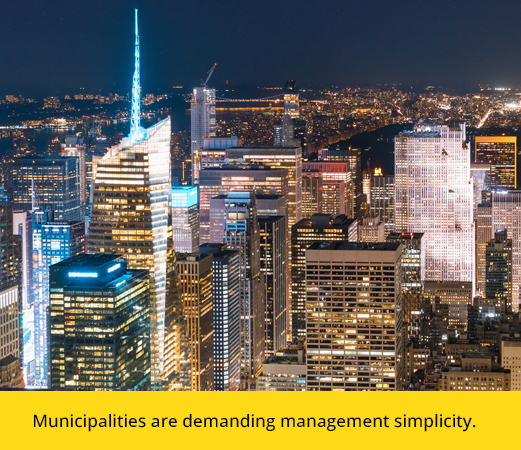
Consolidation Enables Unified Data Across PARCS
The second pillar—data standardization—is only achievable through consolidation. More than 60% of parking facilities still rely on manual or partially manual reporting (NPA). When different operators export spreadsheets from different PARCS systems at different times of day, using different KPI definitions, the owner is left with noise rather than insight.
A single operator can integrate all PARCS systems into a unified BI layer with daily updates, standardized definitions, and portfolio-wide visibility. Earlier, the system flagged issues, identified trends faster, and made asset decisions evidence-based rather than anecdotal. This single-pane-of-glass approach is impossible without consolidation at the operator level.
Consolidation Enables Portfolio-Level Pricing Strategy
Pricing is one of the highest-impact levers in parking asset performance—but it only works when applied consistently. Public datasets from cities such as Seattle, Chicago, and San Francisco clearly show that demand conditions vary widely by block, hour, and neighborhood. Fragmented operators often apply inconsistent pricing logic, creating a patchwork of rates that fail to maximize yield or align with owner objectives.
A unified operator can deploy a coordinated revenue-management strategy, test rate changes across multiple markets, analyze portfolio elasticity, and align pricing with tenant behavior. Without consolidation, owners lose this advantage entirely.
Consolidation Enables a True Portfolio Operating Model
Finally, consolidation lays the groundwork for a full portfolio operating model: standardized SOPs, consistent training, unified customer experience, coordinated maintenance, and synchronized technology deployment. It mirrors what CRE owners already expect in industrial, retail, and multifamily asset classes.
This model also accelerates innovation. Rolling out new systems—such as LPR, mobile validation, EV charging, or digital receipts—is dramatically faster when one accountable operator oversees all markets.
Portfolio consolidation isn’t simply a trend; it’s the structural transformation the parking industry has resisted for too long. Owners want clarity, accountability, and consistency—and they want a partner who can integrate revenue growth, unified data, pricing strategy, and modern operations into one cohesive system.
A single point of contact is the umbrella under which the entire next generation of enterprise parking performance becomes possible.
Sign up for updates on this five-part series and other insights.
In Focus:
Navigating the Two-Customer World
How Parking Has Exposed the Post-Pandemic Customer Divide
As many companies navigate RTO (Return to Office) challenges, it is clear that the workplace has changed since 2020, and understanding that change does not start with office attendance surveys or hybrid-work forecasts. It starts with parking. As the first and last touchpoint of the workplace journey, parking reveals a generational divide that is reshaping employee expectations, tenant decision-making, and the performance of office assets across North America.
The Emergence of Two Distinct Customer Types
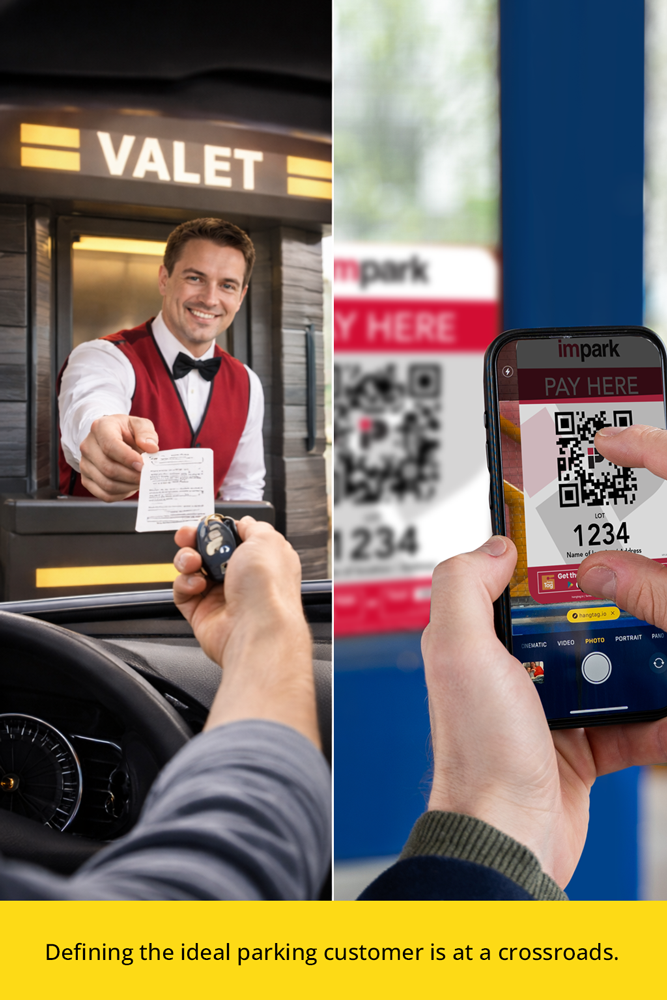
As distant a memory as it may be, the pandemic has created two distinct types of workers, and parking sits at the intersection of both. The first group consists of high-touch traditionalists: employees, shoppers, and visitors who value human guidance, face-to-face reassurance, and simple, predictable service. They appreciate attendants, physical signage, and clear instructions. For them, parking is a stress point in the urban experience, and human presence reduces uncertainty.
The second group is the digital-first individualist: commuters who expect every step of the journey—entry, payment, validation, and exit—to be automated. They assume frictionless experiences powered by their phones. For them, waiting in a line to pay, speaking to a parking attendant, or navigating outdated kiosks is not just inconvenient; it signals that the property is behind the times.
Today, most office properties serve customers simultaneously—and this is where the tension begins.
Parking Mirrors the Hybrid Work Divide
The push-and-pull between these two customer profiles mirrors today’s hybrid work dynamics. Some employees still prefer traditional routines and derive comfort from personal interactions. Others see commuting as something they want to optimize, digitize, and complete quickly. Parking has become an unexpected battleground for confusion over customer experience preferences, shaping whether people choose to enter a building at all.
This divide also plays an increasingly important role in tenant satisfaction and asset performance. With office occupancy still hovering around 50–55% in major U.S. markets, parking is increasingly used as a strategic lever to entice employees back to the office. A seamless parking journey—consistent signage, intuitive entry, smart validations, digital receipts—makes the commute feel lighter. Conversely, friction at the garage undermines the tenant’s entire workplace strategy.
Parking as a Behavioral Economics Engine
Importantly, parking is no longer a commodity. It is a behavioral economics engine. Dynamic pricing can steer drivers toward underutilized inventory, prepaid passes can encourage more frequent visits, and digital validation can help tenants manage hybrid schedules. The ability to shape demand through experience and incentives gives parking managers a degree of influence they have not had in years.
The promotion and presentation of parking services necessitate meeting customers at their point of contact, whether online, at the physical location, or through alliances, and should be coupled with pricing strategies that cater to the customer’s preferences, with the understanding that real value arises when relevance and service converge at the specific moment of the transaction.
Designing a Two-Lane Operating Model
Doing this effectively requires embracing a two-lane operating model: high-touch when needed, high-tech everywhere else. Operators must design a human-friendly fallback path while anchoring the system in a digital backbone. This means investing in staff training while also deploying mobile payments, LPR-based access, digital communication channels, and integrated validations.
The challenge is delivering both journeys without increasing cost-to-serve. Reinventing the customer experience must come from operational redesign, not simply layering new tools on old workflows. Operators that build from a modern data and technology foundation can flex between human and digital channels based on customer type, time of day, and demand conditions.
Parking as a Microcosm of the Workplace
Transition
In this sense, parking has become a microcosm of the broader workplace transition. It reflects the clash between legacy routines and digital expectations—between employees who return for community and those who return only when necessary. How a property manages parking increasingly signals how it manages everything else.
For owners and operators, mastering this duality is essential for the next decade of urban mobility and office recovery. The winners will be those who build a single operational backbone that can deliver two different customer journeys—effortlessly, consistently, and without friction.
Perspectives:
Practical AI for the People
Moving Beyond Buzzwords to Deliver People-Driven Results
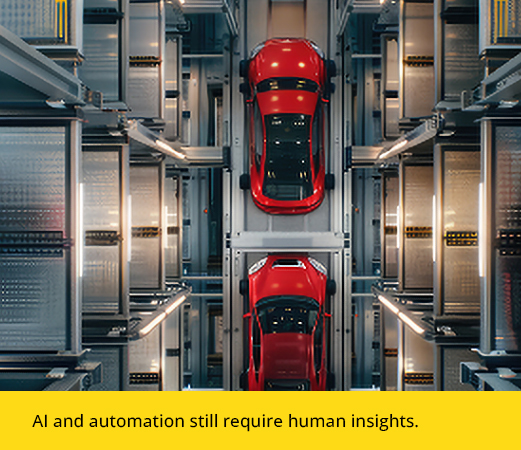
The parking industry is experiencing a surge of attention around artificial intelligence, but the actual value of AI isn’t found in futuristic predictions or abstract vision-deck presentations. The real opportunity lies in practical, operationally grounded use cases that improve the customer journey, elevate facility performance, and reduce friction for frontline teams. AI’s most transformative impact is not conceptual—it’s hands-on, and it depends on people.
The Pressures Facing Today’s Parking Operators
Across North America, operators face growing pressure: rising customer expectations, tightening labor markets, and increasingly complex portfolios with multiple PARCS, and reporting environments. Practical AI addresses these challenges head-on.
Where Practical AI Delivers Immediate Impact
- Cut exit queues before they form with predictive traffic modeling
- Deflect the top 20 customer questions instantly through automated chat and voice
- Staff smarter, not heavier, using historical and forecasted demand patterns
- Catch equipment failures before they go dark, preventing downtime
- Eliminate validation friction and reduce tenant complaints
- Expose revenue leakage early by flagging irregular transactions
- Deliver one consistent customer voice across every channel and property
Each of these use cases removes manual burden, reduces operational drag, and improves customer satisfaction. None requires speculative AI models. They require data discipline, operational design, and frontline integration.
Trust as the Foundation for Scaled AI
But there’s a deeper truth: AI only works at scale when built on trust. Clients will not adopt automation unless they are confident that their data, payment systems, and customer interactions are protected. In enterprise real estate, that confidence must be proven—not asserted.
Why Security Certifications Matter
This is why Reimagined Parking’s investment in ISO 27001 certification, along with aligned controls across SOC 2, ISO 9001, and PCI, is so important. ISO 27001 is not a checkbox; it is a globally recognized framework for securing information systems, governing access, enforcing consistent risk management, and ensuring continuous monitoring. For a parking operator, certification signals that AI-powered workflows—from customer messaging to financial reporting—operate inside a rigorously audited security environment.
In a landscape where many vendors race to attach the term “AI” to their offerings, certifications provide a clear differentiator. They reassure owners, especially institutional CRE stakeholders, that automation and machine learning are being deployed responsibly. They also set a high bar for incident response readiness, data governance, and cross-system integration—non-negotiable requirements when dealing with PARCS data, license plate recognition systems, mobile payments, and tenant validation platforms.
Scaling AI Across the Full Operating Chain
For operators, a secure AI foundation enables scaling. Once data protection is standardized, AI can be embedded not just in customer service but across the entire operational chain: labor planning, equipment maintenance, asset reporting, pricing analysis, loss prevention, and more. Every part of the business becomes faster, more predictable, and more accountable.
Avoiding AI FOMO
The industry must be cautious, however, not to fall into what many call “AI FOMO”—deploying tools without a clear problem to solve. The smartest operators will resist black-box models, gimmicky pilots, or overly complex architecture. Instead, they will focus on tools that make work easier, reduce operational noise, and deliver measurable business outcomes.
AI in parking does not need to be revolutionary to be transformative. It needs to be purposeful. With the right discipline—prioritizing usability, security, and frontline adoption—AI becomes a quiet force multiplier. It reduces calls, accelerates throughput, improves uptime, and creates a more consistent customer experience.
AI as Infrastructure for Enterprise Mobility
For enterprise clients, this is the future of mobility operations: AI that is practical, secure, and performance-driven. Technology that amplifies people rather than replaces them. Tools that deliver clarity, not complexity. All anchored in a security posture strong enough for institutional real estate.
This is not AI as a buzzword. It is AI as infrastructure— that is still people-driven, and it is already changing the industry.
Sign up to receive this newsletter in your inbox. Questions or comments on any topic? Contact us.