





Moving Forward Newsletter
Vol 5, August 2026
Moving Forward >
Our Volume 5 issue continues our
Five-Part Parking Trends Series on Parking Portfolio Management.
In our third installment of “Parking Portfolio Management,” we conclude by discussing how companies need to prepare for current and upcoming changes in the parking industry.
V. Parking Trends Series
A Crossroads Moment for Parking
The New Era of Parking Management is Becoming a Reality for Many.
Across these four previous articles, an obvious pattern has emerged. Parking businesses can continue operating under an isolated, fragmented 20th-century model, but doing so will limit their future performance. Beyond industry rhetoric, the organizations that successfully transition to integrated, portfolio-level operations will be best positioned to compete.
The industry’s longstanding fragmentation—across operators, pricing strategies, revenue management, and data systems—is increasingly incompatible with today’s realities. Hybrid work, demand volatility, and higher owner expectations require greater coordination than ever before.
Consolidation has become the foundation for a more connected parking business, where modernization is supported by unified intelligence rather than disconnected technologies. Together, these changes point toward a larger transformation: helping owners translate structural change into sustained portfolio performance.
Parking as a Performance Engine
Parking is no longer simply being modernized—it is being reimagined. What was once a collection of individual facilities, local managers, and disconnected systems is becoming a coordinated operating model where revenue, pricing, and

The parking industry is going through modernization. How deeply is it changing?
data work together across an entire portfolio.
Parking was once viewed as a utility that simply needed to function. That approach worked when demand was predictable, and customer expectations were lower. Today, hybrid work has reshaped occupancy patterns, digital experiences have raised expectations, and owners increasingly expect parking assets to contribute measurable value.
As a result, parking must perform like every other component of a real estate portfolio. It must be measurable, responsive, and accountable. Operators are evolving from service providers into strategic partners responsible for pricing, technology, customer experience, and business performance.
This increased complexity makes integration more valuable than ever. While consolidation reduces vendor management, its greatest advantage is operational coordination. A unified view of inventory and pricing enables more effective digital sales. Shared operational data improves customer experience, while responsive pricing better reflects actual demand. Together, these capabilities transform parking into a higher-performing business asset.
Parking increasingly resembles other enterprise disciplines such as revenue management, logistics, and portfolio operations. Although the assets remain physical, competitive advantage now comes from how intelligently the portfolio is managed. Organizations that recognize this shift early will be better positioned to improve NOI and create long-term value.
Questions for the Future of Parking
The organizations gaining an advantage are not necessarily those with the newest hardware or the largest software stack. They are the ones building coordinated systems around visibility, accountability, and execution. They are integrating data across portfolios rather than managing properties independently, treating pricing, marketing, operations, business intelligence, and customer experience as interconnected disciplines.
The parking industry is reaching the same conclusion that has already reshaped commercial real estate and enterprise operations: fragmentation slows intelligence, while coordination accelerates it.
Bringing the future into your business does not begin by asking, “What technology should we buy?” It begins by asking more fundamental questions:
- Is parking functioning as a collection of locations?
- Are our pricing, sales distribution, and growth strategies coordinated?
- Can we measure performance consistently across assets?
- Do our operators and systems communicate with one another in real time?
The answers to these questions will determine which portfolios adapt successfully and which continue operating reactively.
The next generation of parking performance will belong to organizations that treat intelligence as infrastructure: centralized revenue management, unified data environments, coordinated pricing, modern customer acquisition, and operational accountability working within a single integrated framework.
This transformation is already underway. The tools exist. The operating models are proven. Economic pressures continue to accelerate adoption. The remaining question is not whether the industry will change, but whether organizations will help shape that change—or be forced to respond to it later.
Moving from Portfolio Ambition to Portfolio Reality
Managing parking as a portfolio requires more than placing multiple locations under a single contract. It requires people who understand how the pieces work together, systems that show what is actually happening, and the ability to act on that information across locations and markets.
At Reimagined Parking, three specialized teams sit at the center of that work: ParkNexus BI Studio, Digital Marketing, and Revenue Management.
Together, we call this Revenue Performance Maximization (RPM).
The idea behind RPM is straightforward. Each team brings its own expertise, and their value increases as they work together. Business intelligence shows what is happening. Digital marketing helps create and direct demand. Revenue management uses pricing and inventory to turn that demand into stronger performance. Information flows among the three, giving each team a stronger foundation for its work.
Reimagined Parking—which includes Impark, Lanier Parking, Republic Parking, AmeriPark, and ParkOne—can apply this expertise across a large and varied base of parking operations. Local teams still respond to the needs of their individual markets,

Intelligent pricing strategies are the emerging growth engine.
but they also have access to specialists, tools, data, and lessons learned across a much larger organization.
That scale matters. Performance patterns become easier to identify. Pricing changes can be tested and measured. Marketing programs do not have to be rebuilt from scratch for every facility. Under-used inventory can be identified earlier. Strategies that work in one location can inform decisions elsewhere.
RPM is how that knowledge becomes practical.
RPM: Unifying Data Through the BI Studio
Most parking operations depend on several systems for gates, payments, permits, license plate recognition, enforcement, reservations, and monthly parking. When those systems do not communicate, owners are left piecing together reports to understand what is happening.
BI Studio brings that information together and turns it into clear dashboards. Supported by the ParkNexus Integration Hub, it connects data from different parking technologies and creates a consistent view across individual locations or an entire portfolio.
Owners can monitor revenue, occupancy, payment behavior, enforcement activity, monthly parker usage, peak demand, and location-level performance. They can identify under-used inventory, track digital adoption, compare payment methods, spot exceptions, and see where revenue may be lost.
This is the intelligence side of RPM: creating a reliable picture of performance so decisions about pricing, marketing, staffing, enforcement, budgeting, and capital planning are based on evidence rather than assumptions.
RPM: Turning Visibility into Demand Through Digital Marketing
Knowing what inventory is available is only useful if customers can find and buy it.
Parking customers increasingly find spaces through search engines, navigation tools, digital listings, reservation platforms, event sites, and other online channels. Managing those channels one facility at a time can lead to outdated information, inconsistent listings, and missed demand.
Reimagined Parking’s in-house Digital Marketing team manages this work across locations while still paying attention to the needs of individual facilities. Listings, content, digital assets, and online reputation are continually reviewed to make parking easier to find and purchase.
AI supports these workflows by improving speed, consistency, and efficiency, while people remain responsible for oversight and decision-making.
Reimagined Parking’s custom booking widgets adds another channel for customers. Property, event, hospitality, and partner websites will be able to offer parking reservations directly via a simple integration, turning existing website traffic into an additional source of parking demand.
Within RPM, digital marketing connects available inventory with potential customers. It helps make sure the right parking is visible when and where people are looking for it.
RPM: Turning Demand into Performance via Pricing and Inventory Management
Pricing is one of the strongest tools available to a parking owner, but it works best when pricing and inventory are managed together.
Demand can change by block, hour, day, season, customer type, event schedule, and surrounding land use. When facilities set rates independently, owners can end up with inconsistent prices that do not reflect actual demand. Some inventory may sit unused while other locations or time periods are priced below what the market will support.
Reimagined Parking’s Revenue Management team looks across those conditions rather than treating each rate as a separate decision. The team analyzes occupancy, transactions, demand patterns, tenant behavior, competitive conditions, local events, and other performance data to identify where rates or inventory strategies should change.
Across multiple locations, pricing decisions can then be tested and compared. The team can see where customers are price-sensitive, where demand can support higher rates, where inventory needs greater exposure, and how changes affect both occupancy and revenue.
This is where the other parts of RPM become especially useful. BI Studio shows where inventory is underperforming. Digital Marketing can help generate demand for that inventory. Revenue Management can adjust pricing based on what happens next.
Instead of three separate activities, they become a continuous cycle of seeing, acting, measuring, and improving.
Bringing RPM Together
The practical value of RPM lies in the connection among its three parts.
BI Studio shows what is happening. Digital Marketing helps generate demand. Pricing and Inventory Management determine how that demand can produce better results.
Each capability has value on its own. Working together, they give owners something much harder to build location by location: a repeatable way to understand performance, find opportunities, act on them, and measure the result.
That is where Reimagined Parking’s scale becomes important. The company is not simply bringing more locations under one operating structure. It is bringing together people with specialized knowledge in data, marketing, pricing, technology, operations, and customer behavior—and giving them a common view of the portfolio.
Revenue Performance Maximization (RPM) puts that talent to work as a connected system.
For owners, the advantage is practical. They do not have to assemble separate teams, vendors, data sources, and processes to solve each problem independently.
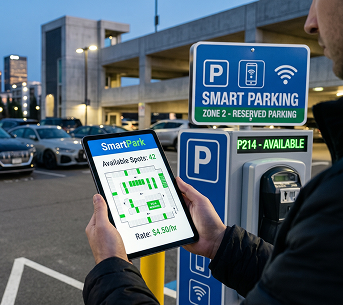
The next step in digitization is portfolio-level integration.
Much of that expertise already exists inside Reimagined Parking and is already working across a broad range of parking environments.
As parking becomes more dependent on data, digital demand, and the active management of pricing and inventory, the depth of expertise required becomes increasingly difficult to replicate on a one-facility basis. The opportunity is not simply to gain access to three more services. It is to put a much larger body of knowledge to work to improve the portfolio’s performance—and avoid leaving capabilities, customers, and revenue opportunities unused.
Determining the best approach to creating a consolidated solution to your parking needs demands a chat with experts. If you are interested in discussing this further, please schedule a call today.
Interested?
Book a call with one of our portfolio advisors.