






Moving Forward Newsletter
Vol 4, April 2026
Moving Forward >
Our Volume 4 issue continues our Five-Part Parking Trends Series on Parking Portfolio Management.
This series will reveal how the very nature of parking is evolving into a strategic, tech-enabled asset class aligned with broader real estate and mobility trends.
Part One can be viewed here.
II. Parking Trends Series
Digital and the End of ‘Door-Knocking’
Centralized Digital Strategy Is Parking’s New Growth Engine
For decades, parking revenue growth followed a familiar formula: local managers cultivated relationships block by block, knocked on nearby office doors, negotiated monthly contracts, and raised rates incrementally as demand allowed. Known as ‘door-knocking,’ it was a way growth strategies commonly worked. That playbook made sense in a world of stable commuting patterns and predictable occupancy. Today, in the post-COVID era, these opportunities are clearly in decline.
A Structural Shift in Demand, Not a Temporary Dip
Urban parking demand has not snapped back evenly. Office occupancy across major North American markets continues to plateau around 50–55% of pre-pandemic levels, according to Kastle Systems. Now, hybrid work is structural, not transitional. This means operators can no longer rely on volume events to boost recovery and lift revenue, nor can they simply push rate increases without risking further erosion of demand. Headwinds such as congestion taxes and public transportation expansion are also major drivers of change in the industry. With all this change, growth has become harder, and operators have to be more strategic.

The old forms of new business acquisition are changing.
Today, the two-customer behavioral paradigm has shifted decisively toward digital-first engagement. Research from McKinsey and eMarketer shhows that across the array of personas in mobility categories—ridesharing, micromobility, EV charging—customers expect to purchase and manage services digitally. Parking is no exception. Consumers now find parking through search, apps, event platforms, navigation tools, and personal referrals. In contrast, many parking organizations still rely on hyper-local, analog sales tactics that cannot scale or adapt to volatile demand.
From Field Tactics to Centralized Revenue Intelligence
This mismatch is forcing a structural pivot in revenue generation. The operators winning today are not adding headcount or relying on legacy field tactics. They are building centralized commercial engines that combine digital marketing, pricing intelligence, partnerships, and analytics into a single growth function. Reimagined Parking’s Shunt Madanyan, VP Revenue Management, notes the major change, “Parking has been priced by intuition for decades. Now we’re replacing that with revenue analytics.”
Shaping Demand Through Coordinated Digital Strategy
A centralized digital strategy enables parking operators to shape demand models rather than passively wait for revenue to appear. Digital acquisition campaigns can target commuters on in-office days, event attendees during peak windows, or neighborhood visitors during off-peak hours. Pre-paid products and validations can be distributed through employer programs, tenant portals, and event partnerships. Pricing can be adjusted dynamically to convert interest into clear utilization without suppressing volume. Shunt Madanyan adds, “Parking shouldn’t be priced (solely) garage by garage. It should be a centrally managed portfolio, with one coordinated revenue strategy.”
Reimagined Parking’s approach illustrates this shift with the addition of Vincent Raguseo as Chief Growth and Marketing Officer and his team, who bring extensive expertise to in-house pricing, partnership development, and centralized revenue management. Seeing the challenge between rear and front echelons of the business, Vincent ruminates: “Relying on individual location managers to drive growth is increasingly challenging; we are bringing a coordinated commercial strategy to perform in a lower-volume, highly competitive environment.”
The new reality is that growth strategies, commonly practiced at the local level, can now be effectively managed from a central view and coordinated with local markets.
Building the Modern Commercial Engine
The implication for owners is clear: revenue growth is no longer just a local activity. It is a portfolio-level discipline that depends on data, digital channels, and coordinated execution. Door-knocking has not disappeared entirely—but it is no longer a primary growth engine.
The future belongs to operators who are fiscally and technically savvy and treat parking revenue the way modern businesses treat demand: centrally, measurably, and digitally.
III. Parking Trends Series
From Blind Spots to One Source of Truth
How Unification with PARCS Data Is Parking’s New Infrastructure
Parking has always been data-rich and insight-poor. Every transaction, entry, exit, validation, and exception generates information—yet much of that data has historically remained siloed inside disconnected systems. Today, this reality has become one of the industry’s greatest liabilities.
An Industry Rich in Data, but Poor in Insight
Most enterprise parking owners operate a patchwork of PARCS technologies: legacy system gates alongside modern LPR systems, physical meters beside cloud-based platforms. According to the National Parking Association’s 2025 Pulse report, more than 60% of North American facilities still rely on disparate or partially manual reporting. The result is familiar to asset managers: delayed reports, inconsistent definitions, manual reconciliation, and limited confidence in the numbers. Reimagined Parking’s CTO Matt Lindenberger looks at the change differently: “Digital transformation didn’t unify parking—it fragmented it.”
From an Optional Upgrade to an Operational Necessity
Stable parking demand and forgiving margins once allowed people to tolerate these blind spots. In today’s environment, they are unacceptable. Owners and CRE stakeholders—guided by firms like PwC and Deloitte—now view real-time data integration as one of the highest-impact drivers of technology ROI. Without it, pricing decisions are slower, capital investments are harder to justify, and operational risks remain hidden.

A fully integrated operating model enables the centralized management of numerous parking facilities.
Unified data infrastructure has therefore shifted from a “nice to have” to a baseline requirement. When PARCS data from every location is ingested daily into a standardized business intelligence layer, the entire operating model changes. Occupancy trends become visible across markets. Revenue anomalies surface earlier. The system identifies equipment issues before they escalate into downtime. Portfolio benchmarking becomes credible rather than theoretical.
Moving From Fragmented Data to Full Integration
Reimagined Parking’s Business Intelligence (BI) Studio offers a concrete example of this evolution. The platform integrates data across all environments, including PARCS—regardless of vendor—into a single portfolio-wide dashboard. Even analog data can be transposed into their platform. Definitions have been standardized. Updates are daily. The platform shares insights across teams and clients.
The impact goes beyond reporting efficiency. Unified data changes the nature of decision-making. Matt adds: “The industry evolution from cash to credit was the last major change; with data-rich on-site and back office assets, the industry is leaving the digital era and entering the intelligence era.” Now internal conversations are shifting from anecdotal explanations to evidence-based examples. Instead of isolated site narratives, consistent metrics, pricing adjustments, and staffing plans will bolster capital upgrades. Owners gain a shared factual baseline with their operator, reducing friction and accelerating action.
From Data Collection to Data Activation
As portfolios grow larger and more complex, unified dashboards are becoming the industry’s operating backbone. They are the foundation for pricing strategy, AI deployment, risk management, and investor reporting. In a fragmented data environment, parking remains reactive. The time for effective intelligence management is clearly the industry’s call to action. Matt adds, “The winner won’t be the one with the most software. It will be the one who knows how to instrument and activate the data.”
VI. Parking Trends Series
The New Era of Pricing Responsiveness:
Why Portfolio-Level Rate Strategy Is Parking’s Next Frontier
Pricing has always been one of the most powerful levers in parking—but also one of the most inconsistently applied. Across North America, parking rates vary dramatically, even for comparable assets. Public data from municipal transportation departments in cities like San Francisco, Chicago, and Seattle show that price sensitivity can shift block by block and hour by hour, influenced by work schedules, events, transit availability, and neighborhood dynamics.
The Cost of Intuition-Driven Rate Setting
Despite this complexity, many owners managing 10 to 50 locations still rely on hyper-local pricing decisions. Site or city managers set independent rates, often based on intuition rather than data. The result is predictable: underpriced assets in high-demand windows, overpricing during soft periods, and missed opportunities to shape the response through rate design.
Organizations facing these challenges will need to rely on deeper expertise to optimize their parking strategy. Reimagined Parking’s Steve Aiello, Executive Vice President – US, adds: “Using a range of pricing data doesn’t create value on its own—experienced analysts turn data into strategy.” Yet embracing insights can be challenging when there are many data sources to consider.
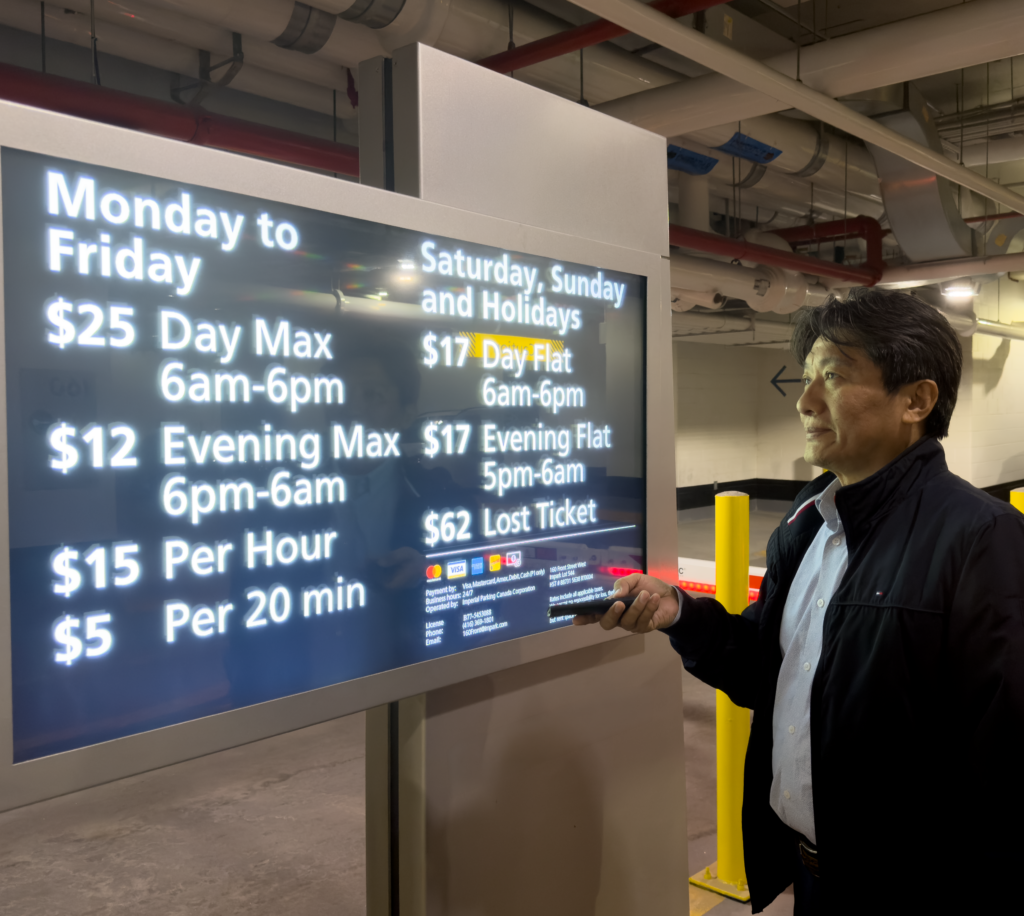
Navigating pricing complexities demands new strategies.
Configurability: The Key to Modern Pricing Strategy
Other industries solved this problem years ago. Hospitality, airlines, and car rental agencies use centralized pricing functions to manage yield across portfolios. These approaches routinely deliver 5–12% increases in revenue, not through blunt rate hikes, but through smarter alignment between demand, price, and availability. The magic word is ‘configurability’.
Configurability in parking is now following the same path. Portfolio-level pricing strategy enables operators to analyze market-level elasticity, systematically test rate changes, and coordinate pricing with marketing campaigns and tenant behavior. The strategic optimization of pricing, facilitated by digital acquisition, which is key to driving both feature desirability and demand generation, ensures we experience concurrent improvements in utilization and yield rather than a situation where one comes at the expense of the other.
Aligning Price, Demand, and Digital Acquisition
This approach also supports owner objectives beyond revenue alone. Pricing can be used to smooth peak demand, encourage off-peak utilization, support tenant retention, and align parking behavior with broader asset strategies. But none of this is possible when pricing decisions are fragmented across operators or regions.
There are issues in cities where dynamic pricing is not an accepted practice. Reimagined Parking’s Tarek Moussa, EVP, Portfolio Management, says: “Clients don’t want to manage five vendors—they want one partner who can solve the whole problem. For example, in New York City, price variability can be a time-consuming challenge, but you can centrally circumvent this by implementing tailored strategies.” As the industry and municipalities evolve, it has been increasingly important to stay ahead of disruptions and local pricing restrictions.
Centralized pricing transforms parking from a static utility into a responsive commercial system. It creates consistency without rigidity, local sensitivity without chaos, and growth without guesswork. For owners seeking predictable NOI in an unpredictable market, portfolio-level pricing is no longer optional—it is the next frontier of parking performance.